Category: Pop-Culture

  • The Alt-Right’s Meltdown Over Superman and Why I’m Loving It

    The Alt-Right’s Meltdown Over Superman and Why I’m Loving It

    Originally posted on Project-Nerd.

    Since its early July release, the far alt-right crowd has been crying online about Superman. After an incredibly busy start to the month, I finally carved out time to see James Gunn’s new film, and I’ll say it outright: those far-right critics are right. The movie is incredibly woke. And I’m here for every bit of it.

    After years of playing second fiddle to Disney’s Marvel, Warner Bros finally admitted their DC theatrical universe was headed in the wrong direction. Whether you loved or loathed Zack Snyder, Henry Cavill, Joss Whedon, and the others from recent DC projects, it’s undeniable that Warner’s strategy wasn’t working. So, on October 25, 2022, they made a decisive move and named James Gunn and Peter Safran co-chairmen and co-CEOs of DC Studios.

    Gunn, still juggling television projects somewhat associated with the DCEU, quickly announced that the first film in the new DCU would be Superman, and he’d be writing and directing it himself.

    Now, in July 2025, Gunn’s Superman has finally hit theaters. And while the president is neck-deep in a self-made Epstein scandal (yes, trump’s obviously on that list), tanking the economy, pushing racist immigration agendas, and supporting genocide abroad, his voting fanbase seems more focused on a fictional superhero with a strong, positive message.

    Warning: Spoilers for Superman (2025) Ahead
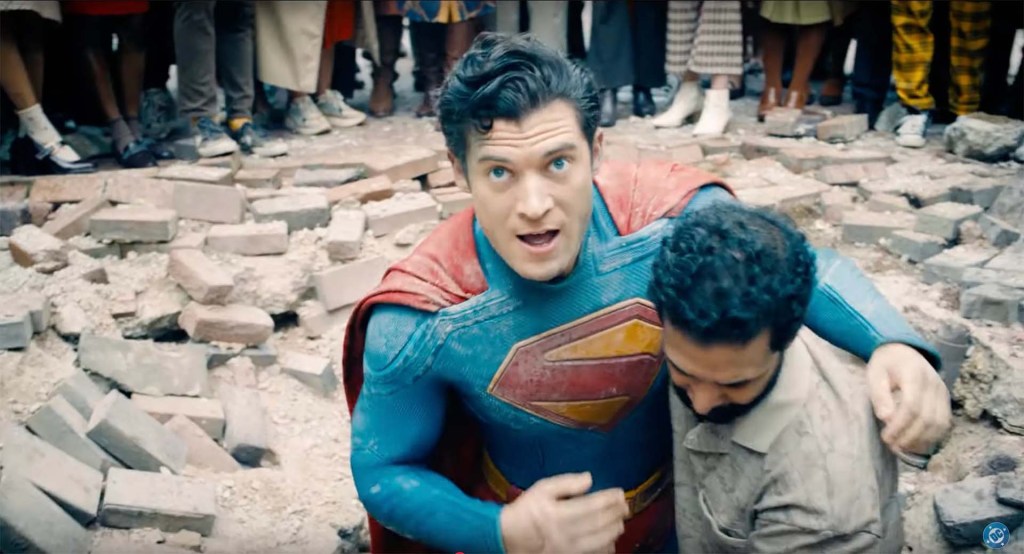
    Superman 2025

    Instead of celebrating Warner Bros. and DC’s triumphant return with a compelling Superman, the internet is swirling with debates over whether Gunn’s film is “woke” along with whether the film contains a statement on Israel’s invasion of Gaza.

    Gunn hasn’t confirmed any of that. He’s mostly dismissed the noise. But after watching the film, I’ve formed my own opinion: the far right is correct. Gunn’s Superman is woke. And I love it.

    David Corenswet portrays Superman, already three years into his heroic journey. There’s no origin story, no costume montage, no fumbling for an identity. Superman and Clark Kent are fully formed, and Lois Lane (played by Rachel Brosnahan) is completely in the know.

    With the origin story out of the way, Gunn dives straight into his original plot, loosely drawing from existing comic arcs. The film opens with Superman intervening in the Boravia Conflict—an invasion between fictional nations Boravia and Jarhanpur. Gunn wrote this plot well before the current administration took office, but its eerie similarities to real-world events, much like Andor, have angered the far right.

    Remove politics for a moment, and the facts remain: James Gunn did exactly what he was hired to do. He revitalized DC’s cinematic universe and made Warner Bros a boatload of money.

    And more simply, he made a great movie. Gunn’s Superman is fantastic.

    Superman Movie Still

    Corenswet brings depth and humanity to Superman. The supporting cast shines. Gunn’s emotional mastery is in full force, drawing us into powerful moments as Clark wrestles with whether his true self might disrupt his closest relationships.

    Yes, the film has its flaws. But Gunn delivered a big movie with complex characters and intertwining themes that crescendo beautifully. When The Teddybears and Iggy Pop’s “I’m a Punkrocker” explodes near the end, the emotional impact is undeniable. That happens because the story parallels real life, through both Superman’s internal battles and the broader socio-political undertones.

    Gunn didn’t appear to set out to make a political statement. Rather he made a movie that is real. And in 2025, “real” automatically becomes political. Because basic human rights, war crimes, and compassion are now contentious talking points on the American political spectrum.

    Superman poses a powerful question: how does one responsibly use unmatched power to protect lives? In one scene, Superman defends his intervention in an ally’s invasion simply by saying, “people were going to die.” It’s that raw, simple moral compass, protect those in danger, regardless of political red tape, that drives the plot. And yes, the fictional Boravia-Jarhanpur war Gunn conceived in 2023–2024 now echoes Israel’s real-life conflicts and trump’s increasingly authoritarian rhetoric.

    To be blunt, Gunn’s fictional world, where Lex Luthor would gain control of half of Jarhanpur if the invasion succeeded, mirrors trump’s very real aspiration to eradicate and privatize Gaza. Gunn didn’t write this in response, he wrote it prior to trump’s public statements. But are any of us surprised that reality caught up to fiction?

    I have decided to believe that Gunn did intend to make a statement, whether subtly or not, against maga culture and its leader. But even if he didn’t, the movie reflects the world we live in. And that reflection alone makes it “woke” in the eyes of conservatives.

    But let’s be honest, “woke” isn’t a real thing. It’s a hollow label wielded by crooked politicians and echoed by blind followers to distract from harmful, narrow-minded policies.

    So no, James Gunn didn’t make a “woke” Superman movie. The far right simply decided that basic human decency is now “woke.” That may render their arguments about the film accurate, but it’s at the fault of their own bidding.
  • The Shedeur Truth

    The Shedeur Truth

    As I begin my thoughts here, I think it’s important to point out a few things. First, I have no direct evidence to support any claims I will make against the NFL and professional sports in this op-ed—aside from what those leagues reveal to us every year. I also acknowledge that I am writing this from a place of privilege as a white male who no longer watches the NFL (for reasons beyond what I’m about to discuss).

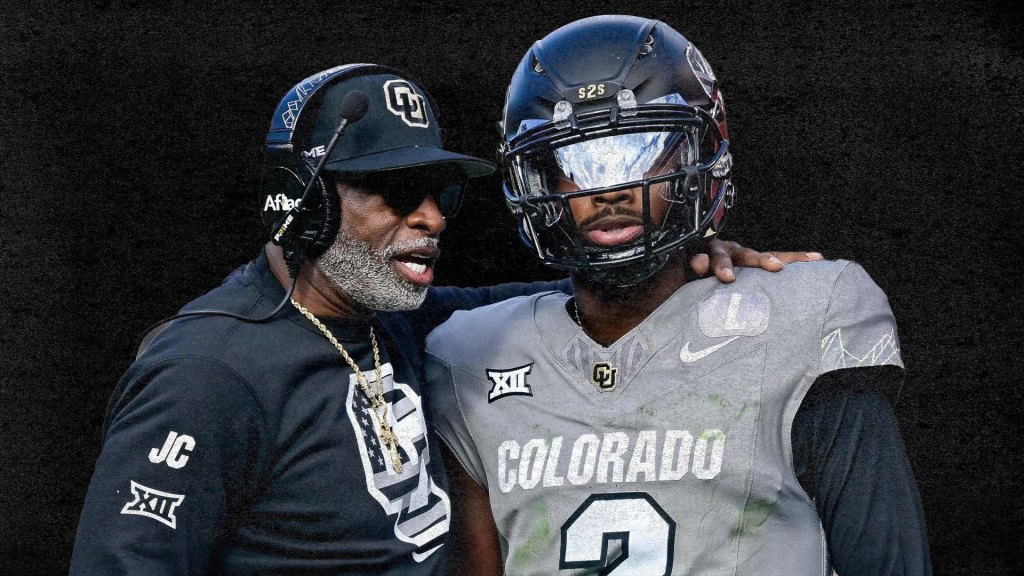
    With that out of the way, let’s address the elephant in the room. The free fall Shedeur Sanders experienced in the 2025 NFL Draft is nothing short of billionaire collusion—completely in line with what league owners have demonstrated time and time again.

    Sanders has dominated at every level. His record-setting performance and high draft stock had little to do with his father, Deion, and certainly nothing to do with nepotism. In 2024 alone, Sanders passed for over 4,000 yards with 37 touchdowns to 10 interceptions, completing a record 74% of his pass attempts—all while being sacked 42 times. Over two years at Colorado, he endured 94 sacks yet missed only two games across his entire collegiate career.

    Keyboard warriors will undoubtedly point to Colorado’s 4-8 record in 2023—a result of a coaching staff in their first year at the D1 level and Sanders’ first year there. A 4-8 season that basement dwellers wish they could string together themselves.

    But beyond college stats, what did the scouts truly say about Sanders?

    Mel Kiper Jr., the most respected draft analyst in the game, called Sanders the best quarterback in the draft.

    ESPN’s Steve Muench provided this scouting report: “Sanders is physically and mentally tough. He takes big hits to make plays and can elevate his game in critical situations. He held onto the ball too long and tried to make too much happen in 2024, but he’s shown the ability to get the ball out and pick defenses apart with short to intermediate passes over the course of his career. Sanders can throw receivers open, holding safeties with his eyes and getting through his progressions given time and space. He keeps his eyes downfield as he moves around the pocket, and he makes off-platform throws. His arm is strong enough to make every throw, and he can pass into tight windows when he gets the ball out on time and with anticipation. He also can scramble for first downs.”

    But it wasn’t just experts backing Sanders—the odds supported him as well. In December 2024, his odds of being drafted number one were so strong that a bettor would need to wager $180 to win $100. By the week of the draft, that same bet would have returned $18,000.

    So, what changed?

    Some media outlets attribute it to his NFL Scouting Combine interviews. Unnamed front-office officials from certain teams labeled him “arrogant” and “unprofessional.”

    Arrogant? What record-setting D1 quarterback isn’t arrogant? If arrogance were an issue, why was Travis Hunter still selected second overall? And why did Caleb Williams go number one in 2024, with Marvin Harrison Jr. taken fourth?

    I believe the real issue lies in how the wealthy white men running teams interpret the word “unprofessional”—a criticism Deion Sanders himself has frequently heard at the collegiate level. But we all know what Houston Texans owner Bob McNair means when he says “unprofessional.”

    Collusion is something people often accuse NFL owners of. And although the league’s special deals with the government—along with certain owners’ relationships with past and sitting U.S. Presidents—have kept it from ever being convicted of collusion, even the casual fan can see that it’s there.

    Sure, Colin Kaepernick may have benefited from how the fallout of his kneeling protests played out, becoming a martyr rather than just an above-average quarterback. But how does a Black quarterback who led a team to a Super Bowl get locked out of the league while a white placekicker who regularly makes anti-LGBTQ remarks continues receiving support from his owner? And how did Ben Roethlisberger continue his career after settling a rape lawsuit?

    Of course, plenty of Black athletes get away with things, too—Houston’s Joe Mixon is a prime example. But Mixon played by the rules. He nodded when told to nod. He said what his PR team scripted for him.

    Shedeur Sanders, just like his father Deion, refuses to conform to the outdated mold of a 1980s quarterback—the Father Figure the NFL owners desire. Just like Deion, Shedeur will continue breaking barriers, evolving the position, and reshaping the league to appeal to a new, younger audience. An audience fed up with Boomer Billionaire Bullsh*t™. An audience that wants end-zone celebrations in the NFL, bat flips in MLB, and ice-in-the-veins gestures from NBA stars who nail clutch three-pointers.

    As Sanders fell down the draft board, I kept thinking about the more than $200 million the Cleveland Browns gave to sex offender Deshaun Watson. Or the fact that the Pittsburgh Steelers are still openly pursuing the human equivalent of a soiled diaper in Aaron Rodgers. It’s abundantly clear that team owners would rather tolerate legal and social scandals than deal with the media frenzy that comes with drafting Deion’s kids—or accepting the inevitable cultural shift within the league.

    But sure, white football fans can keep insisting it’s Shedeur’s “arrogance” knocking him down a peg—while they proudly wear their Trevor Lawrence jerseys. And let’s not pretend Watson and Rodgers don’t walk around with more arrogance than Brett Favre and Tom Brady combined.

    Yeah. Now that I think about it (and read my cease and desist letter from the NFL), it’s clearly the arrogance—not owner collusion—that’s devaluing yet another flashy athlete.

  • The Cultural Significance of Kendrick Lamar’s Halftime Show

    The Cultural Significance of Kendrick Lamar’s Halftime Show

    Football fan or not, it’s possible that you were one of the roughly 120 million viewers who tuned in to the Super Bowl to see a dynasty get tested and their opponent play nearly a perfect 60 minutes of football. But mixed in with the commercials, the big game, and plenty of Kevin Burkhardt praising Rupert Murdoch (the human equivalent of black mold), many were not expecting to be treated to what might be the most culturally significant and important Super Bowl Halftime Show of all time.

    Kendrick Lamar was announced as the Super Bowl performer back near the beginning of the NFL’s 2024 season. Right in the middle of his epic rise from superstar to legend, mostly due to his most recent Drake diss track, “Not Like Us.” His song had taken over airwaves, phone apps, and—inappropriately—even the halls of middle schools and high schools all across the country.

    The fact that Roc Nation and Apple chose him to headline, with only limited cameos from other musical artists, shows how significant Lamar was becoming. His epic rise, fueled by his beef with dimming superstar Drake, saw the two verbally attacking each other with finesse across more than nine different musical tracks.

    But if you think Lamar’s performance and lyrics during the halftime show were all about Drake, you weren’t paying attention.

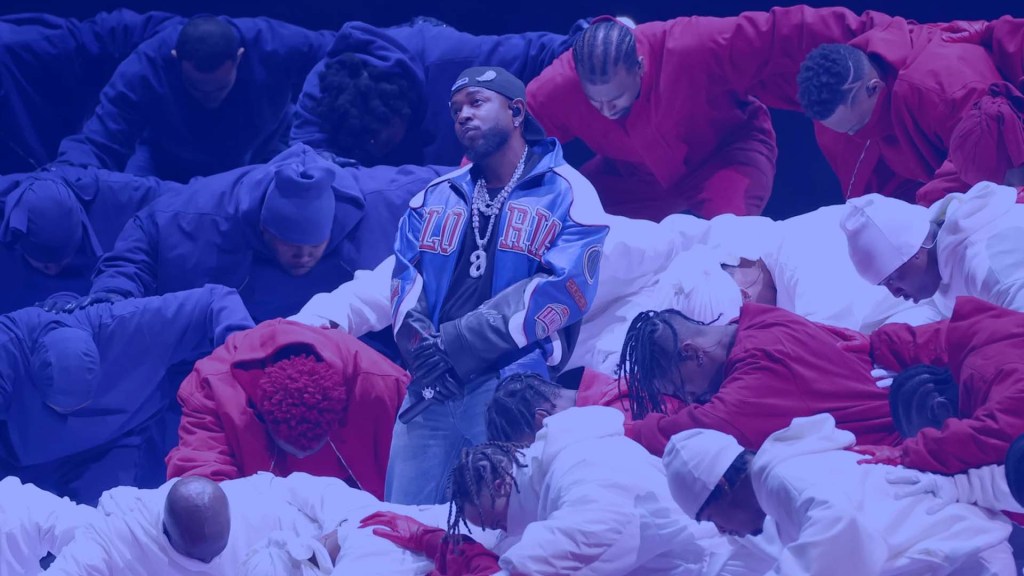
    From the very first line of “the revolution ’bout to be televised, you picked the right time but the wrong guy” to closing with the message filled, “TV Off,” Lamar and company pulled absolutely no punches.

    Samuel L. Jackson came out dressed in a very patriotic red, white, and blue, doubling as both America’s current Uncle Sam and Lamar’s conscience, telling the hip-hop artist he was “too loud, too reckless, too ghetto” and that he needed “to tighten up!”

    Jackson’s “ghetto” remark was likely a response to the letter sent by a group of Republican Louisiana lawmakers to the Greater New Orleans Sports Foundation ahead of the big game, demanding Lamar’s halftime show not be “lewd” or “offensive” like they felt some performances of the past had.

    During “Humble,” audiences were unexpectedly treated to 60 dancers dressed in red, white, and blue, lined up to look like the American flag. As Lamar stood in the middle, fracturing the flag, he sang about coming from poverty, a place so many in this country continue to be trapped in.

    Even Serena Williams’ crip walk was more significant than its surface appearance. Yes, she had dated Drake, and yes she was symbolically dancing across his career’s grave, but Williams has also been one of the most dominant presences in a predominantly white sport where she had previously been criticized for dancing in a similar fashion in celebration of her gold medal at the London Olympics in 2012. Critics at the time stated her dance was inappropriate and even a glorification of gang violence.

    His nearly 12-minute set set the internet on fire well before he was done and saw Donald Trump leave about halfway through it. Although Trump’s departure was likely pre-planned so he could get back to burning the constitution in Washington, DC, with him probably not even picking up on a hint of what Lamar was putting down, his cronies were much more aware of what was happening.

    Right-wing influencers and politicians were all over the internet making not-racist racist remarks about the performance. Rep. Lauren Boebert asked if she was “the only one needing subtitles for this!!” Former Rep. George Santos called the show “absolute TRASH.” Eric Daughtery, Madison Cawthorne, and any other wealthy white MAGA influencer born from a trust fund had something negative to say. And to no surprise, Matt Gaetz seemed unimpressed as well, possibly when he found out Lamar was speaking against grown men hitting on “a minor.”

    The 12 minutes meant something and, more importantly, stated something. Lamar, like many other Americans, was getting back up off the mat and was showing he was ready to start speaking up again. For Hims might have ignorantly used Childish Gambino’s “This Is America” in an ad about how much they overcharge for weight loss support, but Lamar was making sure you looked right past that and saw what America really is.

    But even if you were only there for “Not Like Us” and were excitedly gleaming “A Minor” simultaneously with a hundred million others, it’s important to understand why that song has become what it has become. Kendrick Lamar’s “Not Like Us” didn’t win best song and album of the year at the Grammys because it was a cleverly written diss track; it took home some of music’s most prestigious awards because it has become an anthem and a war cry during a very tumultuous time.

    Yes, almost all the lyrics of the track are specific to Drake, as intended by Lamar, but the words “they not like us” is a reminder that those who support the racism, sexism, and homophobia of the far-right, or even those who tolerate it because of a specific promise or agenda they support, well, they are not like us.