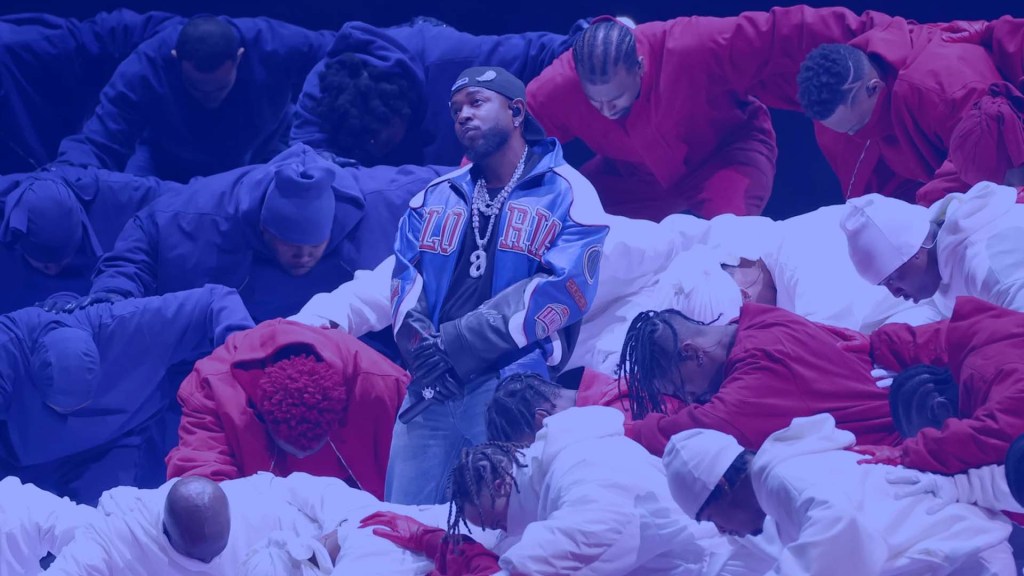
Football fan or not, it’s possible that you were one of the roughly 120 million viewers who tuned in to the Super Bowl to see a dynasty get tested and their opponent play nearly a perfect 60 minutes of football. But mixed in with the commercials, the big game, and plenty of Kevin Burkhardt praising Rupert Murdoch (the human equivalent of black mold), many were not expecting to be treated to what might be the most culturally significant and important Super Bowl Halftime Show of all time.
Kendrick Lamar was announced as the Super Bowl performer back near the beginning of the NFL’s 2024 season. Right in the middle of his epic rise from superstar to legend, mostly due to his most recent Drake diss track, “Not Like Us.” His song had taken over airwaves, phone apps, and—inappropriately—even the halls of middle schools and high schools all across the country.
The fact that Roc Nation and Apple chose him to headline, with only limited cameos from other musical artists, shows how significant Lamar was becoming. His epic rise, fueled by his beef with dimming superstar Drake, saw the two verbally attacking each other with finesse across more than nine different musical tracks.
But if you think Lamar’s performance and lyrics during the halftime show were all about Drake, you weren’t paying attention.
From the very first line of “the revolution ’bout to be televised, you picked the right time but the wrong guy” to closing with the message filled, “TV Off,” Lamar and company pulled absolutely no punches.
Samuel L. Jackson came out dressed in a very patriotic red, white, and blue, doubling as both America’s current Uncle Sam and Lamar’s conscience, telling the hip-hop artist he was “too loud, too reckless, too ghetto” and that he needed “to tighten up!”
Jackson’s “ghetto” remark was likely a response to the letter sent by a group of Republican Louisiana lawmakers to the Greater New Orleans Sports Foundation ahead of the big game, demanding Lamar’s halftime show not be “lewd” or “offensive” like they felt some performances of the past had.
During “Humble,” audiences were unexpectedly treated to 60 dancers dressed in red, white, and blue, lined up to look like the American flag. As Lamar stood in the middle, fracturing the flag, he sang about coming from poverty, a place so many in this country continue to be trapped in.
Even Serena Williams’ crip walk was more significant than its surface appearance. Yes, she had dated Drake, and yes she was symbolically dancing across his career’s grave, but Williams has also been one of the most dominant presences in a predominantly white sport where she had previously been criticized for dancing in a similar fashion in celebration of her gold medal at the London Olympics in 2012. Critics at the time stated her dance was inappropriate and even a glorification of gang violence.
His nearly 12-minute set set the internet on fire well before he was done and saw Donald Trump leave about halfway through it. Although Trump’s departure was likely pre-planned so he could get back to burning the constitution in Washington, DC, with him probably not even picking up on a hint of what Lamar was putting down, his cronies were much more aware of what was happening.
Right-wing influencers and politicians were all over the internet making not-racist racist remarks about the performance. Rep. Lauren Boebert asked if she was “the only one needing subtitles for this!!” Former Rep. George Santos called the show “absolute TRASH.” Eric Daughtery, Madison Cawthorne, and any other wealthy white MAGA influencer born from a trust fund had something negative to say. And to no surprise, Matt Gaetz seemed unimpressed as well, possibly when he found out Lamar was speaking against grown men hitting on “a minor.”
The 12 minutes meant something and, more importantly, stated something. Lamar, like many other Americans, was getting back up off the mat and was showing he was ready to start speaking up again. For Hims might have ignorantly used Childish Gambino’s “This Is America” in an ad about how much they overcharge for weight loss support, but Lamar was making sure you looked right past that and saw what America really is.
But even if you were only there for “Not Like Us” and were excitedly gleaming “A Minor” simultaneously with a hundred million others, it’s important to understand why that song has become what it has become. Kendrick Lamar’s “Not Like Us” didn’t win best song and album of the year at the Grammys because it was a cleverly written diss track; it took home some of music’s most prestigious awards because it has become an anthem and a war cry during a very tumultuous time.
Yes, almost all the lyrics of the track are specific to Drake, as intended by Lamar, but the words “they not like us” is a reminder that those who support the racism, sexism, and homophobia of the far-right, or even those who tolerate it because of a specific promise or agenda they support, well, they are not like us.
 Political Geekery
Leave a comment